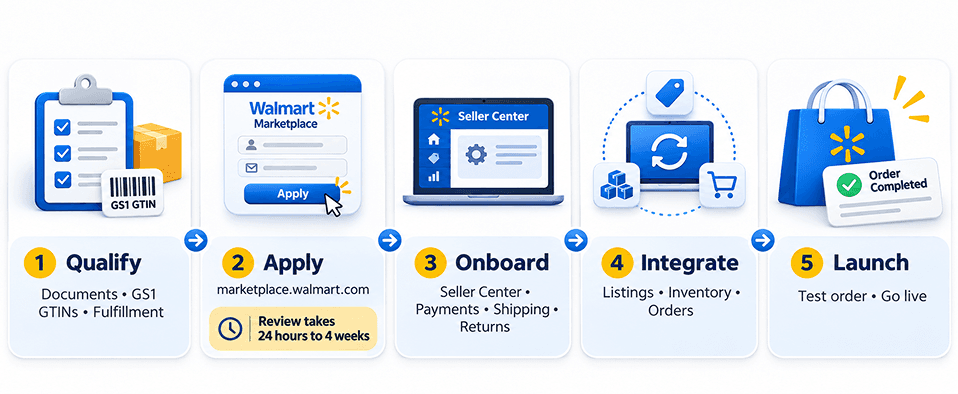
To sell on Walmart Marketplace, apply at marketplace.walmart.com with a business tax ID (Walmart does not accept an SSN), documents that verify your business name and address, ecommerce sales history, GS1 GTINs, and a US fulfillment setup or Walmart Fulfillment Services. Walmart charges no signup or monthly fee. You pay a 3% to 20% referral fee on each sale.
We sell on Amazon and Shopify and want Walmart too, but approval and setup look confusing.
If that sounds like your team, this guide is for you: ecommerce directors at Shopify and BigCommerce brands adding Walmart as a third channel without adding a second job for operations.
The timing matters. Walmart's U.S. marketplace grew net sales 52% year over year in the second quarter of fiscal 2027, according to Walmart's earnings call.1 Below you will find the requirements, the start-up steps, dated fees, and how to connect Walmart listings, inventory and orders to your store and ERP.
Disclosure: Redefine builds marketplace integrations and the Redefine Suite marketplace hub. We say plainly where a simpler setup is enough.
What Are the Requirements to Sell on Walmart?
To sell on Walmart, you need a business tax ID (not an SSN), a personal ID, documents verifying your business name and address, ecommerce sales history, GS1 GTINs, a compliant catalog, and a US fulfillment setup or Walmart Fulfillment Services (WFS).2
For example, a Shopify brand with two years of Amazon sales and its own GS1 company prefix usually meets every requirement on day one. Check them in this order, because each depends on the one before it:
- Business tax ID or license. A US business tax ID (EIN) or business license number, plus your entity classification. Walmart states that it does not accept an SSN.
- Personal ID. A copy of the applicant's government ID.
- Business name and address documents. Enter the name and address exactly as they appear on your EIN paperwork. Walmart warns that mismatches cause EIN validation errors.
- Ecommerce sales history. A record of existing marketplace or online sales, such as Amazon or Shopify.
- GTINs with a GS1 company prefix. Walmart requires UPCs or GTINs that trace to a GS1 company prefix, so barcodes registered to another company will not qualify.
- A compliant catalog. Every product must comply with Walmart's Prohibited Products Policy.
- A fulfillment plan. A US B2C warehouse with returns capability that meets Walmart's Seller Performance Standards, or WFS.
Requirements checked against Walmart's official onboarding guide on 4 November 2026. If your GTINs and attributes sit in separate spreadsheets per channel, consolidate them into one product information management record before you apply, so Walmart, Amazon and your store all read the same data.
How Do You Start Selling on Walmart Marketplace?
To start selling on Walmart Marketplace, apply at marketplace.walmart.com, get approved, complete onboarding in Seller Center, then set up and list your items. Walmart's review takes 24 hours to four weeks, according to Aura.3 Signup is free.2
- Gather your documents. Collect your EIN confirmation, the applicant's ID, proof of business address, entity type and a recent sales history export. Planning estimate: 1 to 2 hours.
- Confirm your GS1 GTINs. Check that every product you plan to list carries a GTIN registered to your GS1 company prefix. Planning estimate: minutes if you own a prefix; several days if you must buy one.
- Submit the application. Apply on marketplace.walmart.com with the legal name from your EIN documents and a business-domain email address. Planning estimate: 30 to 60 minutes.
- Answer verification requests. Reply to any document request the same day so the review does not stall. Planning estimate: elapsed time 24 hours to four weeks, per Aura.
- Complete Seller Center onboarding. In Seller Center, Walmart's seller dashboard, set up payments, fulfillment settings, shipping templates and your return address. Planning estimate: half a day.
- Choose an integration method. Manage items in Seller Center, build on the Walmart API, or connect an approved solution provider (see the sync section below). Planning estimate: one decision meeting.
- Map your items. Match each product to a Walmart category and fill the required attributes, which differ from Amazon's. Central category and attribute mapping avoids fixing the same errors on every channel. Planning estimate: 1 to 3 days for a few hundred SKUs.
- Place a test order and go live. Publish a few items, buy one, and follow it from order to tracking to payout before opening the full catalog. Planning estimate: 1 to 2 hours plus delivery time.
Why Walmart applications get denied
Aura lists mismatched business details, missing EIN verification, thin sales history, prohibited products and free webmail addresses among the most common reasons. You can fix the issue and reapply.3
How Much Does It Cost to Sell on Walmart Marketplace?
Selling on Walmart Marketplace costs $0 to join and $0 per month, plus a 3% to 20% referral fee on each sale (15% in most categories).4 Walmart Fulfillment Services (WFS) adds fees from $3.45 per unit if Walmart ships for you.6
The referral fee applies to the total sales price, which includes shipping, handling and gift wrap.5 Your real cost depends on four things: category, price tier, fulfillment method and storage time.
| Category (referral fee schedule, updated 9 March 2026) | Referral fee |
|---|---|
| Personal Computers | 6% |
| Consumer Electronics; Camera & Photo; Video Game Consoles | 8% |
| Automotive & Powersports; Industrial & Scientific | 12% |
| Home, Kitchen, Decor & Garden; Pet Supplies; Toys & Games; Tools; Everything Else | 15% |
| Apparel & Accessories | 5% up to $15; 10% for $15 to $20; 15% over $20 |
| Beauty, Health & Personal Care; Baby Products | 8% if $10 or less; 15% over $10 |
| Grocery | 8% if $15 or less; 15% over $15 |
| Indoor & Outdoor Furniture | 15% up to $200; 10% on the portion over $200 |
| Jewelry & Precious Metals | 20% up to $250; 5% on the portion over $250 |
| WFS fee (WFS fees guide, updated 27 May 2026) | Rate |
|---|---|
| Fulfillment: 1 lb or less / 2 lb / 3 lb | $3.45 / $4.95 / $5.45 per unit |
| Fulfillment: 4 to 20 lb | $5.75 plus $0.40 per lb over 4 lb |
| Surcharges | Apparel +$0.50; hazmat +$0.50; retail price under $10 +$1 |
| Storage: January to September | $0.75 per cubic foot per month |
| Storage: October to December | $0.75, plus $1.50 for units stored more than 30 days |
| Storage over 365 days (from 30 June 2026) | $2.25 (366 to 450 days); $7.50 (over 450 days) per cubic foot |
Worked example: a $40 kitchen item
| Cost line | Seller-fulfilled | WFS |
|---|---|---|
| Referral fee (15% of $40) | $6.00 | $6.00 |
| Fulfillment (2 lb packed) | Your own pick, pack and postage | $4.95 |
| Walmart fees per unit | $6.00 plus your shipping cost | $10.95 before storage |
Some seller blogs reported referral fee cuts in June 2026, but Walmart's official schedule still showed the rates above when we checked on 4 November 2026. Confirm your category in Seller Center before pricing, and track Walmart margin separately from Amazon and your store in marketplace reporting.
How Do You Sync Walmart Marketplace Inventory With Shopify or Your ERP?
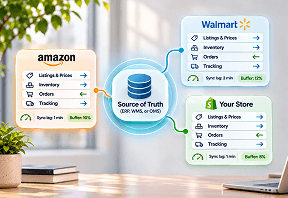
To sync Walmart Marketplace inventory with Shopify or your ERP, make one system the inventory owner, connect it to Walmart through the API or an approved solution provider, and automate stock, order and tracking updates.
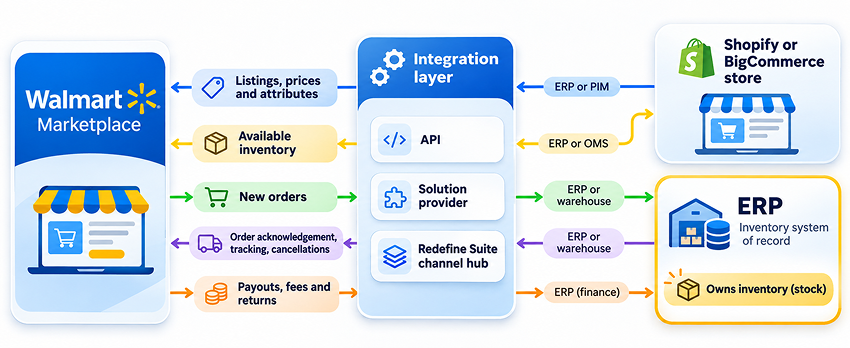
Walmart data flows (text version of the diagram)
| Data | From > To | When |
|---|---|---|
| Listings, prices and attributes | ERP or PIM > Walmart | On change |
| Available inventory | ERP or OMS > Walmart and store | Every few minutes |
| New orders | Walmart > ERP or warehouse | Every few minutes |
| Order acknowledgement, tracking, cancellations | ERP or warehouse > Walmart | As each event happens |
| Payouts, fees and returns | Walmart > ERP (finance) | Daily or per settlement |
Seven steps to sync Walmart with Shopify or your ERP
- Name your inventory system of record. Pick the ERP, OMS or store that owns available stock; every channel reads from it. Planning estimate: one decision meeting.
- Map every SKU. Link each internal SKU to its GTIN and Walmart item so stock and orders match. Planning estimate: 1 to 3 days per few thousand SKUs.
- Authorize the connection. Generate API credentials in the Walmart Developer Portal, or authorize an approved solution provider through OAuth from Seller Center.7 Planning estimate: under an hour.
- Set inventory rules. Define safety stock and per-channel allocation so an Amazon spike cannot oversell Walmart. Planning estimate: half a day.
- Route and acknowledge orders. Pull Walmart orders into your ERP or warehouse system and acknowledge each one in Walmart. Planning estimate: 2 to 5 days to build and test.
- Return tracking automatically. Send carrier and tracking to Walmart when the label prints; Walmart expects valid tracking on 99% of orders. Planning estimate: part of step 5 testing.
- Reconcile payouts and returns. Post Walmart payouts, fees and returns into your ERP so finance sees Walmart margin. Planning estimate: 1 to 3 days.
| Integration method | Best for | Watch out for |
|---|---|---|
| Seller Center (manual or bulk upload) | Small catalogs where Walmart is the first channel | Overselling once Amazon and Shopify share stock |
| Approved solution provider or connector app | Brands on two to four channels with standard workflows | Limited ERP mapping; one more vendor |
| Direct Walmart API build | Teams with developers and large catalogs | You maintain it when Walmart changes its API |
| Unified channel hub on one data model | Multi-channel sellers with an ERP and big catalogs | More setup than an app; overkill for one small store |
Walmart's own Shopify app listing showed as not currently available when we checked on 4 November 2026, so most Shopify sellers connect through a solution provider or a custom build. Redefine's Walmart integration services connect your store and ERP to Walmart items, prices, inventory, orders and returns through the API. For several marketplaces at once, marketplace channel management in Redefine Suite runs Walmart, Amazon and eBay from one catalog and order queue, with multichannel inventory and order sync built in. If the main gap is store to ERP, start with ecommerce ERP integration.
Which Walmart Fulfillment Option Should You Use?
Use Walmart Fulfillment Services (WFS) if you want Walmart to store, pick, pack, ship and handle returns; fulfill orders yourself if your warehouse already meets Walmart's delivery standards. Nearly 50% of Walmart's marketplace business flowed through WFS in Q2 fiscal 2027.1
| Option | Who ships | Main costs | Best fit |
|---|---|---|---|
| Seller-fulfilled (own warehouse) | You | Labor, packaging, postage | Warehouses already hitting 90%+ on-time delivery |
| Seller-fulfilled through a 3PL | Your 3PL | 3PL pick, pack and storage | Brands already using a 3PL for Amazon or Shopify |
| WFS | Walmart | WFS fulfillment, storage, returns | Fast movers, small and light items |
| Hybrid | Both | A mix | Large catalogs: WFS for top sellers, own warehouse for the rest |
In a hybrid setup, WFS stock and warehouse stock must feed one available-to-sell number. An order routing engine decides per order which location ships, so units are not double-counted.
What Mistakes Get Walmart Sellers Suspended?
Walmart suspends sellers who miss its performance standards, such as a cancellation rate above 2%, on-time delivery below 90% or valid tracking below 99%, measured over 30 or 60 days.8 Walmart can suppress listings, suspend or terminate accounts that do not act on a failure.
| Metric (standards updated 28 July 2026) | Standard | Typical cause of a miss |
|---|---|---|
| Cancellation rate | 2% or below | Stock that already sold on another channel |
| On-time delivery rate | 90% or above | Slow handling or the wrong ship-from location |
| Valid tracking rate | 99% or above | Tracking entered late or by hand |
| Late shipment rate | 5% or below | Orders nobody is watching |
| Seller response rate | 95% or above, within 48 hours | No owner for Walmart customer messages |
| Return rate | 6% or below (9% for resold) | Listing data that does not match the product |
| Negative feedback rate | 2% or below | Any of the above |
| Item not received rate | 2% or below | Tracking without carrier scans |
How to avoid the common mistakes
- Overselling from stale stock: a nightly upload leaves sold-out items live, and every cancellation counts. Real-time inventory synchronization closes the gap.
- Manual tracking: one missed tracking number hurts the 99% valid tracking standard on your first orders.
- Unfixed listing errors: wrong attributes drive returns. Listing health diagnostics flag errors before shoppers do.
- Unanswered messages: the 48-hour response window includes weekends.
- Restricted products: check every SKU against the Prohibited Products Policy before publishing.
What Is the Difference Between Walmart Marketplace (3P) and Walmart Supplier (1P/EDI)?
Walmart Marketplace (3P) lets you sell at your own prices through Seller Center or the API; supplier routes (1P and DSV) sell to Walmart at wholesale through EDI. This guide covers the marketplace route.
| Dimension | Marketplace seller (3P) | Supplier (1P) | Drop ship vendor (DSV) |
|---|---|---|---|
| Retail price set by | You | Walmart | Walmart |
| Inventory owned by | You | Walmart, once delivered | You, until it ships |
| How you join | Apply on marketplace.walmart.com | Walmart buyer relationship | Walmart buyer relationship |
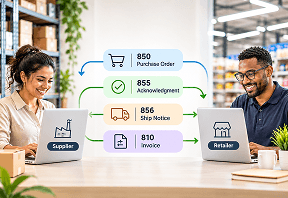
| Order and data exchange | Seller Center, API or solution provider | EDI (850 orders, 856 ship notices, 810 invoices) | EDI or supplier APIs |
| Ships to the shopper | You or WFS | Walmart | You, under Walmart's name |
| You earn | Retail price minus fees | Wholesale price | Wholesale price |
Choose 3P for price control and a faster launch. Choose a supplier route if a Walmart buyer invites you and you can meet EDI requirements. On the supplier route, EDI integration services connect Walmart's EDI documents to your ERP so orders and invoices are not keyed by hand.
Walmart Marketplace Launch Checklist
Run this Walmart Marketplace launch checklist before you apply and again before you open your full catalog.
- Our EIN and business documents show the same legal name and address
- Every SKU we will list has a GTIN under our own GS1 company prefix
- We exported a recent ecommerce sales history
- Every SKU passes Walmart's Prohibited Products Policy
- We chose seller-fulfilled, WFS or hybrid, and costed each
- We know our referral fee and margin per category
- One system owns inventory, and Walmart reads stock from it automatically
- Orders reach our warehouse and tracking returns to Walmart without manual steps
- Someone owns Walmart customer messages, including weekends
- We tracked a test order end to end before going live
If you hold stock in several warehouses, set up multi-location inventory control so Walmart sees one accurate number.
Frequently Asked Questions
Can a sole proprietor sell on Walmart Marketplace?
Yes, if the business has its own tax ID. Walmart asks for a business tax ID or business license number and does not accept an SSN. A sole proprietor can get an EIN from the IRS at no cost and apply with it, as long as the business name and address match across every document.
Do I need my own UPCs to sell on Walmart?
Yes. Walmart requires GTINs or UPCs that trace to a GS1 company prefix, so barcodes registered to another company will not qualify. If you already sell on Amazon with GS1 barcodes, you can use the same GTINs on Walmart and keep one product record across both marketplaces.
Can I reuse my Amazon listings on Walmart?
Partly. Titles, images, descriptions and GTINs carry over, but Walmart uses its own categories and required attributes, so most listings need mapping and some new fields. Strong Amazon content is the best starting point, and our Amazon services team often cleans up both catalogs in one project.
Can I sell on Walmart from Shopify or BigCommerce?
Yes. Shopify and BigCommerce brands connect to Walmart through an approved solution provider, a custom API integration or a multichannel hub. Walmart's own Shopify app listing showed as unavailable on 4 November 2026. Whichever route you pick, decide which system owns inventory before you connect anything.
How long does it take to start selling on Walmart?
Walmart's review takes 24 hours to four weeks, according to Aura. After approval, Seller Center onboarding takes about half a day and item setup takes a few days for a few hundred SKUs, based on the planning estimates in this guide. Clean product data and an existing integration layer shorten every stage.
Is Walmart worth adding if Amazon already works for us?
For brands that meet the requirements, usually yes. Walmart's U.S. marketplace grew net sales 52% in Q2 fiscal 2027, and Walmart charges no monthly fee. The real cost is operational, so add Walmart once inventory, orders and tracking can flow without manual uploads.
The Bottom Line: Add Walmart Without Adding Manual Work
Getting approved on Walmart is a paperwork task; making Walmart profitable is an integration task. Meet the seven requirements, follow the eight steps, price with the dated fee tables, and connect inventory and orders before you scale the catalog.
The same pattern holds on other marketplaces. Off Grid Knives grew annual revenue from $1M to $3.8M over three years with zero paid ad channels, with Amazon contributing 22% of revenue, on a BigCommerce store connected to Klaviyo and Power BI. Off Grid Knives does not sell on Walmart, but the lesson carries over: a marketplace adds revenue when the store, the marketplace and the reporting share one set of data.
"Get approved in weeks. Stay approved by letting systems, not people, keep Walmart in sync."The bottom line
Adding Walmart next quarter?
Send us your channel list, your ERP and how you manage stock today. We will map how Walmart listings, inventory and orders should flow through your stack and the simplest setup that works, even if that is a plug-in app and not Redefine Suite.
Book an integration assessment
Sources & Citations
Official Walmart sources and dated research behind the figures in this guide. All links checked on 4 November 2026.
- Walmart, Q2 Fiscal 2027 Earnings Call Transcript (20 August 2026): U.S. marketplace net sales up 52%; nearly 50% of marketplace business flowed through WFS.
- Walmart Marketplace Learn, Before You Start Selling on Walmart Marketplace (updated 2 September 2026): application requirements, SSN not accepted, free signup, Seller Center onboarding.
- Aura, Why Walmart Marketplace Applications Get Denied (13 March 2025): review takes 24 hours to four weeks; common denial reasons.
- Walmart Marketplace, Referral Fees (checked 4 November 2026): 3% to 20% referral fee range; no setup or monthly fees.
- Walmart Marketplace Learn, Referral Fee Schedule for Contract Categories (updated 9 March 2026): category rates and the total sales price definition.
- Walmart Marketplace Learn, WFS Fees (updated 27 May 2026): Walmart Fulfillment Services fulfillment, storage and surcharge rates.
- Walmart Marketplace Learn, Choose a Solution Provider (updated 6 March 2026): approved solution providers and OAuth connection from Seller Center.
- Walmart Marketplace Learn, Seller Performance Standards (updated 28 July 2026): performance thresholds, measurement windows and suspension consequences.

Umang Patel
Co-owner | Ecommerce Architecture, Systems & Integrations
Umang Patel has worked in ecommerce and technology since 2001. He specializes in backend systems, ecommerce architecture, ERP and platform integrations, automation, and reverse engineering complex business processes. At Redefine Innovations, he leads technology and project teams building scalable systems across both B2B and DTC ecommerce environments.
Areas of expertise: Ecommerce Architecture • Backend Systems • ERP Integration • Automation • Headless Commerce • Reverse Engineering